
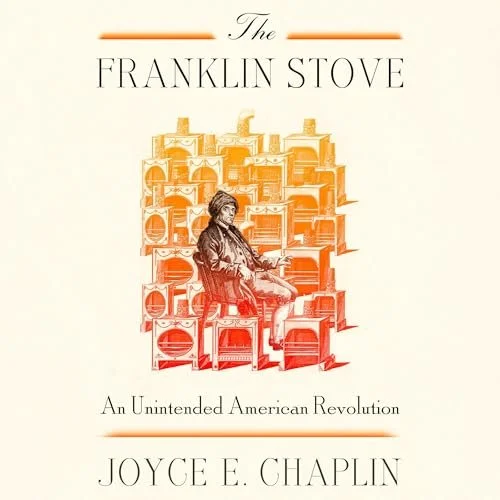
We were treated to a fascinating presentation by Dr. Joyce E. Chaplin - based on her book The Franklin Stove: The Unintended American Revolution. Learn more about her and her book HERE.
Did you know that the biggest revolution in Benjamin Franklin’s lifetime was made to fit in a fireplace. Assembled from iron plates like a piece of flatpack furniture, the Franklin stove became one of the era’s most iconic consumer products, spreading from Pennsylvania to England, Italy, and beyond. It was more than just a material object, however—it was also a hypothesis. Franklin was proposing that, armed with science, he could invent his way out of a climate crisis: a period of global cooling known as the Little Ice Age, when unusually bitter winters sometimes brought life to a standstill.
Franklin believed that his stove could provide snug indoor comfort despite another, related crisis: a shortage of wood caused by widespread deforestation. And he conceived of his invention as equal parts appliance and scientific instrument—a device that, by modifying how heat and air moved through indoor spaces, might reveal the workings of the atmosphere outside and explain why it seemed to be changing. With his stove, Franklin became America’s first climate scientist. As the story of the Franklin stove shows, it’s not so easy to engineer our way out of a climate crisis; with this book, Chaplin reveals how that challenge is as old as the United States itself.
Dr. Joyce E. Chaplin is the James Duncan Phillips Professor of Early American History at Harvard University. She is the author of The First Scientific American: Benjamin Franklin and the Pursuit of Genius, and has published works in The New York Times, The Washington Post, The Wall Street Journal, and the London Review of Books.